

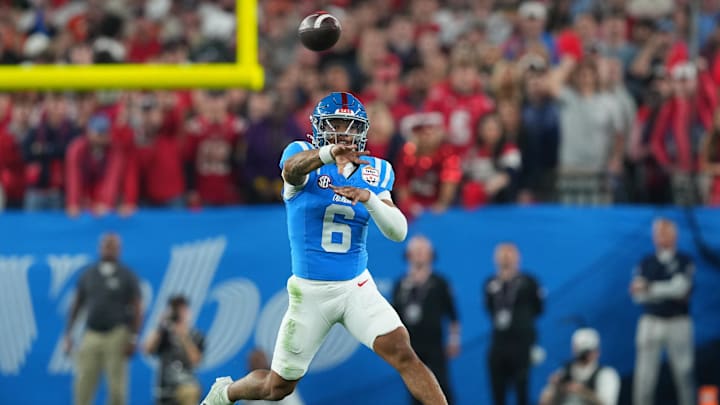
Ole Miss football has a lot riding on what comes out of the Calhoun County Courthouse on Feb. 12.
Whether Trinidad Chambliss returns for another season or would be forced to enter the NFL depends entirely on how the trial between the NCAA and the Rebels' QB plays out.
Just days before they were set to face the QB in court, the NCAA released a 27-page document arguing why the court should not grant Chambliss the preliminary injuction.
NCAA's statement to the court
Filed on Feb. 2 by the NCAA's lawyer, Oxford native J. Douglas Minor, the document highlights four reasons why the court should deny Chambliss the injunction, per The Clarion Ledger.
- It's not the court's role to "second-guess the NCAA's decision" and that the "Mississippi Supreme Court has held that courts cannot interfere with the internal decisions of private membership organizations unless those decisions violate a clear contractual provision or legal duty."
- Chambliss can't prove the NCAA violated the covenant of good faith and fair dealing.
- Chambliss will not suffer irreparable harm without an injunction.
- Public interest favors the NCAA because Chambliss would be taking a roster spot and NIL compensation from others.
The first point in itself should sound concerning for Ole Miss, given the NCAA has denied Chambliss an additional year of eligibility twice; once in January, and once on Feb. 5, when considering his appeal over the initial denial.
Chambliss's attorneys are also bringing their A-game, though. The lawyers of the Rebels' QB have a solid case in making to get Chambliss his additional year of eligibility, backed by the medical documents the NCAA cited as "incomplete," plus testimonies and the support of Ole Miss.
Chambliss' motion for a preliminary injunction is scheduled to be heard on Feb. 12 in the Calhoun County Courthouse.
 Add us as a preferred source on Google